

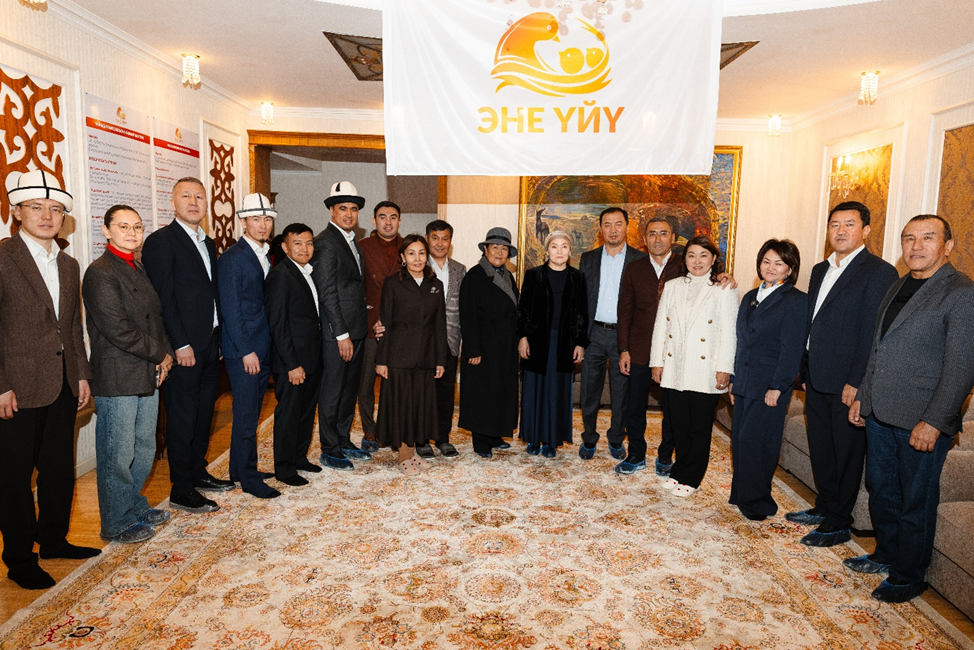
On March 13, the first “Mother’s Home” resource center officially opened in Bishkek. The center will support women with newborns who find themselves in difficult life situations. The first center was sponsored by the founders of the Kyrgyz construction company “Nurzaman.” The opening ceremony was attended by representatives of government bodies, public organizations, the business community of Kyrgyzstan, project initiators Aydin and Anara Rakhimbaev, as well as long-time patrons who have been involved since the project’s inception — Bauyrzhan and Gulhan Isabaev, and Samat Daumov.
Previously, a pilot resource center had already been operating in Bishkek, functioning as a test platform for the project for one year. During this time, the team established cooperation with government structures and social services, and welcomed the first mothers with children. The pilot demonstrated the effectiveness of the assistance model and laid the groundwork for opening a full-fledged center.
Here, mothers can temporarily stay with their child, receive psychological, legal, and social support, restore documents, and find employment. The main goal of the project is to help mothers survive a crisis, keep the child close, regain stability, and learn to be independent.
The project is implemented by the international Mother’s Home International Foundation, established in Kazakhstan. For over 13 years, the foundation has been developing systemic solutions in the field of social orphan prevention.
Today, the project network includes 32 resource centers in different countries:
- Kazakhstan — 20 centers
- Uzbekistan — 8 centers
- Kyrgyzstan — 2 centers
- Ukraine — 1 center
- Malaysia — 1 center
The project is also planned to launch soon in Turkey.
Kuduret Kaariev, founder of the Kyrgyz construction company “Nurzaman,” emphasized that the systematic approach of the project was the decisive factor in supporting the initiative:
“We were looking for an area where help is not one-time, but creates long-term change. This project shows real results: families are preserved, children stay with their mothers. That’s why we decided to join the initiative and develop it further,” he said.
Thus, the initiative, which originated in Kazakhstan, is gradually becoming a regional coalition of Central Asian businessmen united by a common mission — to make the region orphan-free.
Currently, around forty entrepreneurs from different countries are involved in the project. Each of them is a major player in their industry, but within this initiative, state borders no longer matter. Participants are united by a simple idea: there are no “other people’s children,” and the issue of orphanhood in the region can only be solved through joint efforts.
According to Aydin Rakhimbaev, the participation of entrepreneurs makes the project model sustainable.
“Progressive businessmen from different Central Asian countries are joining the initiative. A community of regional business leaders is gradually forming, ready to work together toward the great goal — a Central Asia without orphans,” he noted.
The project’s patrons emphasize that this is not just charity, but a long-term investment in the future of Central Asia. When support is available at the most difficult moment, the child stays in the family, and the mother gets a chance to restart her life.
In the long term, this contributes to the development of human capital across Central Asia. Every child raised in a family becomes a future professional, entrepreneur, teacher, doctor, or engineer, who will build the region’s economy and society.